

The short answer first, because I used to hate reading four paragraphs before anyone told me anything. If you are nervous about wires and you want to finish something before your enthusiasm runs out, buy the smaller ELEGOO Basic Starter Kit. If you already know you will keep going, and you want the extra parts in the house, buy the ELEGOO UNO R3 Super Starter Kit. I own the Super kit and have since September 2024. I have never owned the Basic one, so the right side of this comparison comes from the listings and from twenty-six months of living with the bigger kit.
Here is why I am a reasonable person to ask. In January 2024 my billing department moved to new software and I felt the floor open under me. I was 54. I started learning at the kitchen table after work, Tuesdays and Thursdays from seven to nine, plus Saturday mornings. I bought the Super kit to understand what is physically happening inside a computer, not to become an engineer. The first evening I made a light blink and sat there grinning in an empty room. Finishing the lessons took me until February 2025, one Saturday morning at a time. That is about five months. It is the honest pace of a woman with a full time job and a husband who is not a tech person either.
Before I bought anything I spent about three weeks watching free videos on the HP laptop at the kitchen table. I want to be honest about why that failed. The videos were fine. The problem was that I could watch someone connect a wire and still not believe my own hands could do it. Nothing was at stake and nothing was in front of me. I would watch for forty minutes, feel vaguely informed, and remember none of it on Thursday. The first evening the box was open on the desk in the back room, I learned more in ninety minutes than in those three weeks, because a wire either makes the light come on or it does not, and the board does not care how confident I sound. That is the whole argument for a kit over a video, and it is also the argument for picking a kit you will actually open.
| ELEGOO UNO R3 Super Starter Kit | ELEGOO Basic Starter Kit | |
|---|---|---|
| Cost to start | Higher, because there are more parts in the box | Lower, because there are fewer parts |
| What you build | 22+ guided lessons: blink lights, read temperature, read distance, move a servo | A shorter set built around the first principles |
| Display work | LCD1602 included, with the header already soldered on | The smaller kit does not include a display |
| Desk space and weight | 1.2 pounds, 8.3 by 5.5 by 1.97 inches in the box | Smaller and lighter, easier to keep in a drawer |
| Time to the last lesson | About five months for me, one Saturday morning at a time | Fewer lessons, so you reach the end sooner |
| Parts left over afterward | Servo, display, jumpers and the parts you read temperature and distance with, all reusable | Fewer leftovers to reuse or store |
| What it assumes you know | Nothing. No soldering, no coding, no electronics | Nothing. Same starting point |
Where the ELEGOO UNO R3 Super Starter Kit Wins
The Super kit wins on what there is to do. The listing says 22 or more guided lessons and, from the inside, that is not padding. You blink lights. You read temperature. You read distance. You move a servo. Each lesson is short and each one produces something you can see or touch, and that mattered to me more than I expected it to. When you are 54 and learning something new, the thing that keeps you going is evidence. A light that comes on because of a line you typed is evidence. A number on a screen that matches the temperature in the room is evidence. Nobody has to tell you it worked.
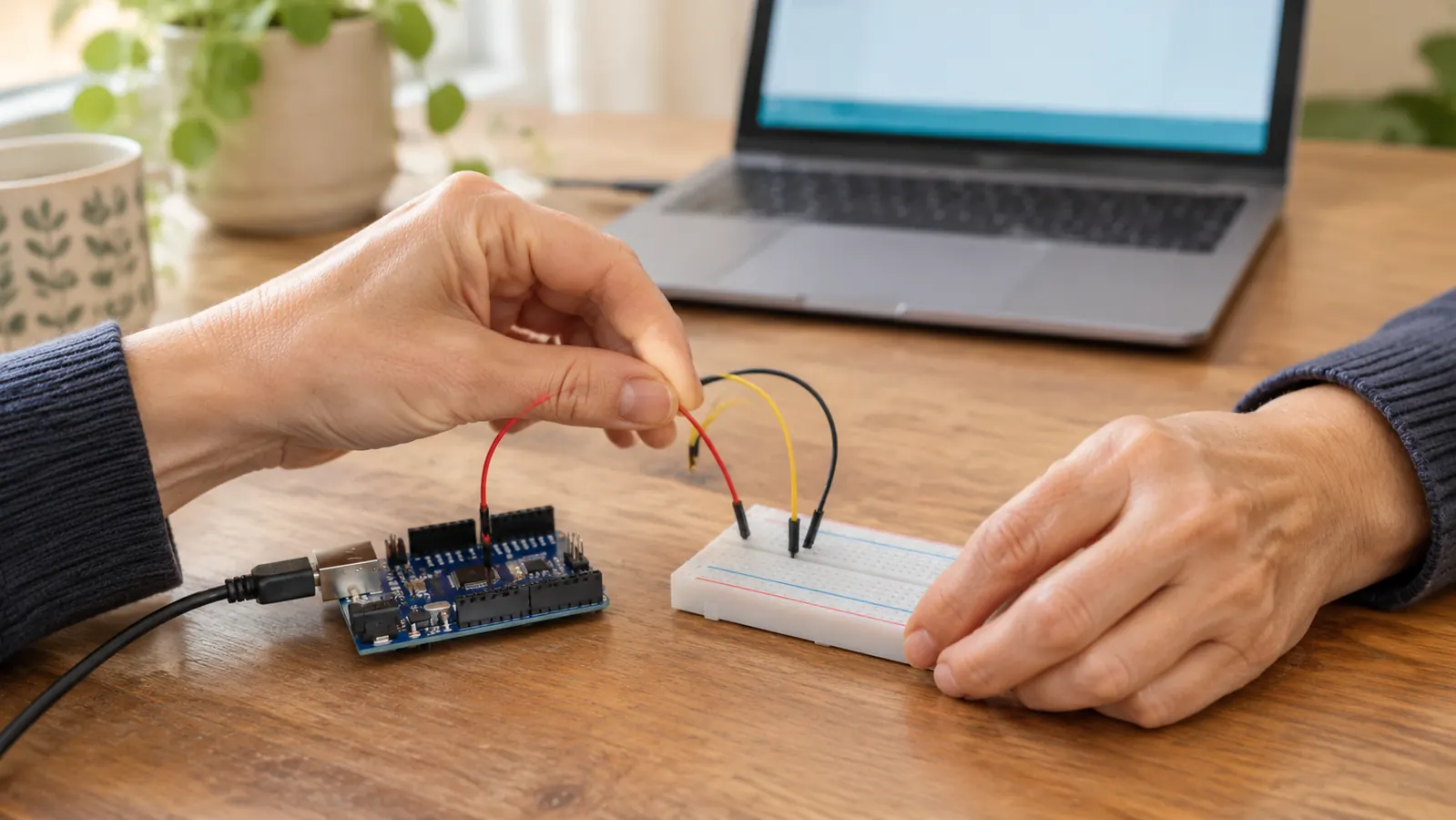
It also wins on parts you will still want after the lessons end. The kit includes the UNO R3 controller board, an LCD1602 display with the header already soldered on, and a breadboard power supply. That pre-soldered header matters more than it sounds. It means the display is a plug-in job, not a soldering job. I have never soldered anything and I never needed to. Those parts do not evaporate when you finish the last lesson. Mine live in the plastic box on the back room shelf and I still pull the box down. The kit also carries a one year manufacturer warranty, which I have never needed to use.
When I got to the lesson with the LCD1602 display, I wired it, ran the example code, and got a screen that lit up with nothing readable on it. I sat there a while assuming I had broken something. What I had done was follow the wiring in the wrong order, matching a row on the breadboard by eye instead of counting down from the lesson page. I pulled every jumper out, counted the rows out loud like a woman talking to herself in an empty room, and put them back. Characters appeared. The lesson had been right the whole time. That sequence, confusion, careful redo, small success, happened maybe six times over five months, and it is the actual curriculum. The PDF tutorial lists the lessons in order and each one assumes only the ones before it, which is why I could pick it up on a Saturday morning after a full week of billing and not have to relearn where I was.
Where the ELEGOO Basic Starter Kit Wins
The Basic kit wins on the thing that stops most people before they start, which is the size of the decision. My kit came with a great many small parts in compartments. Twenty-six months in, I can identify a resistor by sight. In my first week I could not. A kit with fewer parts hands you fewer pieces you cannot name, and it gives the instructions fewer chances to point at a bag you have not opened yet. That is not a small advantage. For the first month it is the whole thing.
It also wins on money and on space. The smaller kit costs less to start with, and that matters when you are not yet sure this is for you. It takes up less room. Mine weighs 1.2 pounds and measures about 8.3 by 5.5 by 1.97 inches in its box, which is fine on a desk in a spare bedroom but is still a real object to store in a one floor ranch house. And it wins on time. My five months was five months of Saturday mornings. A shorter lesson set means you reach the last page sooner, and reaching the last page is what turns a purchase into a habit instead of a box on a shelf.
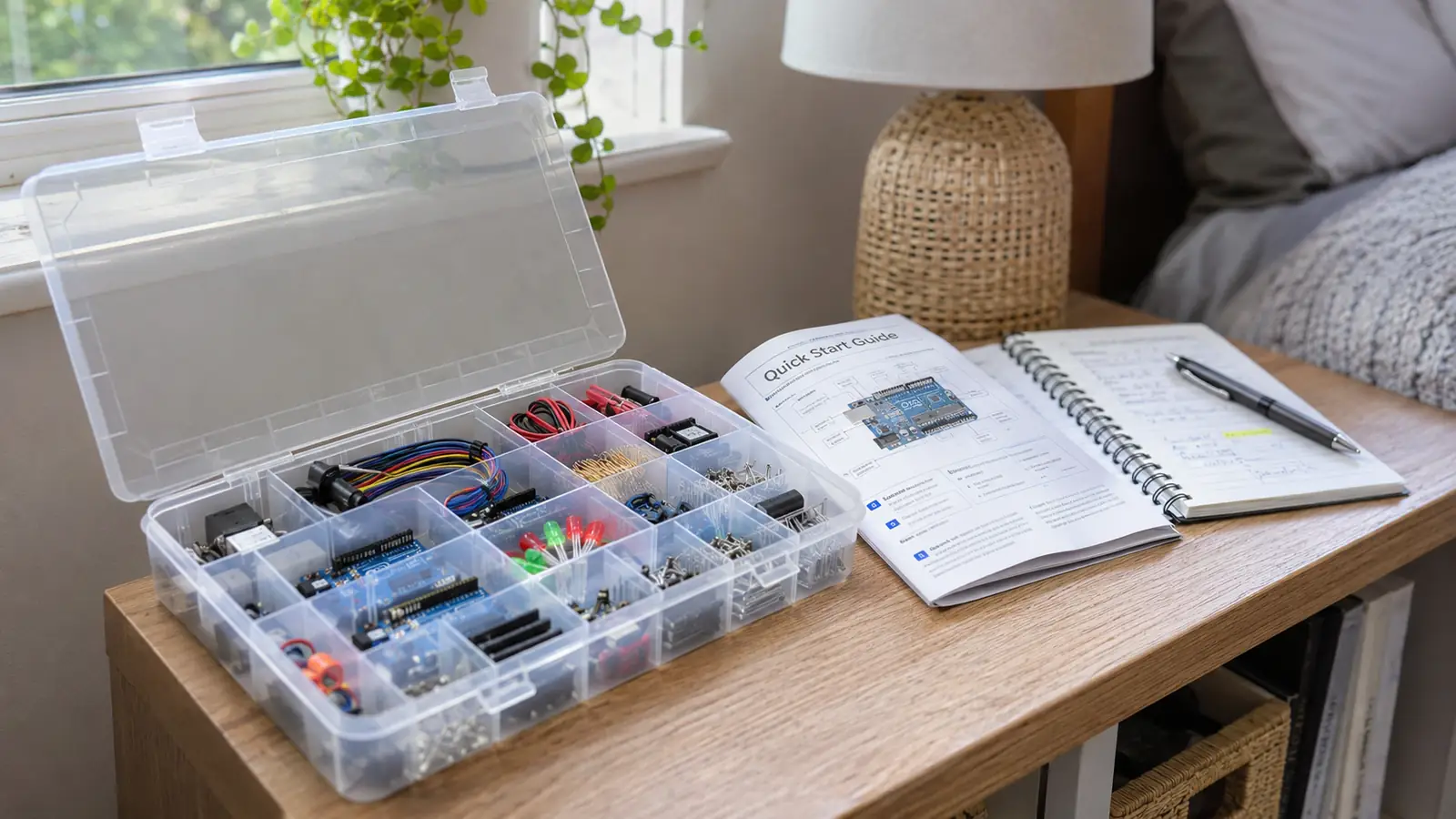
I keep coming back to the sorting, because it is the part nobody warns you about. My parts arrived in a compartmented plastic box and I emptied the bags onto a towel on the back room desk to check them against the list. That took me most of a Saturday morning. Then I put everything back and wrote the part names on masking tape, because the molded labels were too small for me to read without my glasses. That was September 2024 and I still use the tape. The chart that came with the kit is folded and soft at the creases now, and I still cannot call a resistor value by sight without checking it. A beginner with fewer parts does less of that work, and the hour she does not spend sorting is an hour she spends making a light blink. I am not going to pretend the smaller kit is worse for everyone. For a nervous first month, fewer pieces is a kindness.
I skipped one resistor in an early lesson and burned out one LED. The board was fine. That is the worst thing that happened in five months.
The Mistake I Made, and What It Says About Picking a Kit
In one of the early lessons I left out the resistor. I do not remember deciding to leave it out. I remember wanting to see the light come on. The LED burned out, the board was fine, and I did not have to buy anything because the kit had spares. I tell you this because it is the most useful thing I know about kit size. My mistake was a sorting mistake, not a comprehension mistake. More parts in the box means more sorting, and sorting is where a tired beginner at nine in the evening goes wrong.
It happened on a Thursday, around twenty past eight, which is the exact hour when I should stop. I had the lesson page open on the HP laptop, the parts out on the towel, and I was trying to finish before nine so I could sit down with Walt. The resistor was right there in its compartment. I went from the page to the board too fast and skipped it. The LED came on for about two seconds, very bright, and then it did not. I said a word I will not repeat here. The board was fine, which I confirmed by running the previous lesson again from the start. The kit had spare LEDs in a compartment, so nothing was lost except my evening and a little pride. What I took from it is that I do my best work at the start of a session and my worst work in the last twenty minutes. The fix was not a different kit. The fix was stopping when I got tired.
The other thing worth knowing is what the board actually is. The UNO R3 runs at 16 MHz with 2 KB of RAM. Kilobytes, not gigabytes. It is a small computer that does one thing at a time, it connects to your laptop with a USB cable, and it is programmed through the Arduino IDE. If you go in expecting a laptop, you will be disappointed for about a week. If you go in expecting a light that blinks when you tell it to, you will be delighted. Both kits ask exactly the same of you: a computer, the free software, and patience with yourself on the evenings when nothing works.
The kit I own, and the one I can vouch for
The Super kit is the one on my shelf. 22+ guided lessons, the UNO R3 board, the LCD1602 with the header already attached, and a PDF tutorial that walks you through each lesson in order. It is the version I actually used, so it is the version I will answer questions about.
Amazon Check Today's Price on Amazon →Who Should Buy Which
Buy the Basic kit if any of this sounds like you. You are not sure you will like it. You have an hour a week, not a Saturday morning. You want to finish something small and then decide whether to go further. You would rather have fewer parts and a shorter list than more parts and a longer one. There is no shame in the smaller kit. Half of learning this late is protecting your own momentum, and a kit you finish beats a kit you shelve in October.
Buy the Super kit if you already know. If you have looked at a breadboard and started thinking about what you would build with it, if you want a display and a servo and the parts that read temperature and distance waiting in a box because you have a project in mind, the extra parts earn their place. That is what happened to me. I did not buy it to complete a course. I bought it because I wanted to know what was inside the machine on my desk, and the extra lessons answered questions I did not know I had.
Either way, one piece of advice from someone two and a half years into this. Do the first lesson the same evening the box arrives. Not the whole set, just the first one. The gap between opening a box and making something happen is where most of these kits die, and closing that gap on day one is worth more than any difference on the table above.
Pick the one you will actually finish
The smaller kit if you are unsure. The Super kit if you already have a project in mind. I can only vouch for the Super kit, because it is the one that took me from a blinking light to reading a temperature on a screen, and it is the one still in the box on my shelf.
Amazon See the ELEGOO Super Starter Kit on Amazon →