

I failed Core 1 in February 2026 and passed it on the second try in May, and I am telling you that first because the networking chapter of Core 2 is where I got stuck again. Copper cable. Pinouts. Which pin carries what on an RJ45. I read that section at the kitchen table on a Tuesday night and understood maybe half of it. Then I closed the book and did not open it again for eleven days. That is my tell. When I stop opening the book, the material has beaten me and I have not admitted it yet.
What I needed was to watch a cable answer a question. My nephew Theo is a network technician at a school district and he is the only person I ask about this. In September 2025 he lent me his cheap tester for one weekend. It blinks. A light comes on or it does not. I plugged cables into it at the back room desk and learned that a cable was bad, which I already suspected, and nothing about why or how long it was. When I handed it back he said the KLEIN TOOLS Scout Pro 3 would tell me the length and the wiring order, and I wrote the name on the back of an envelope.
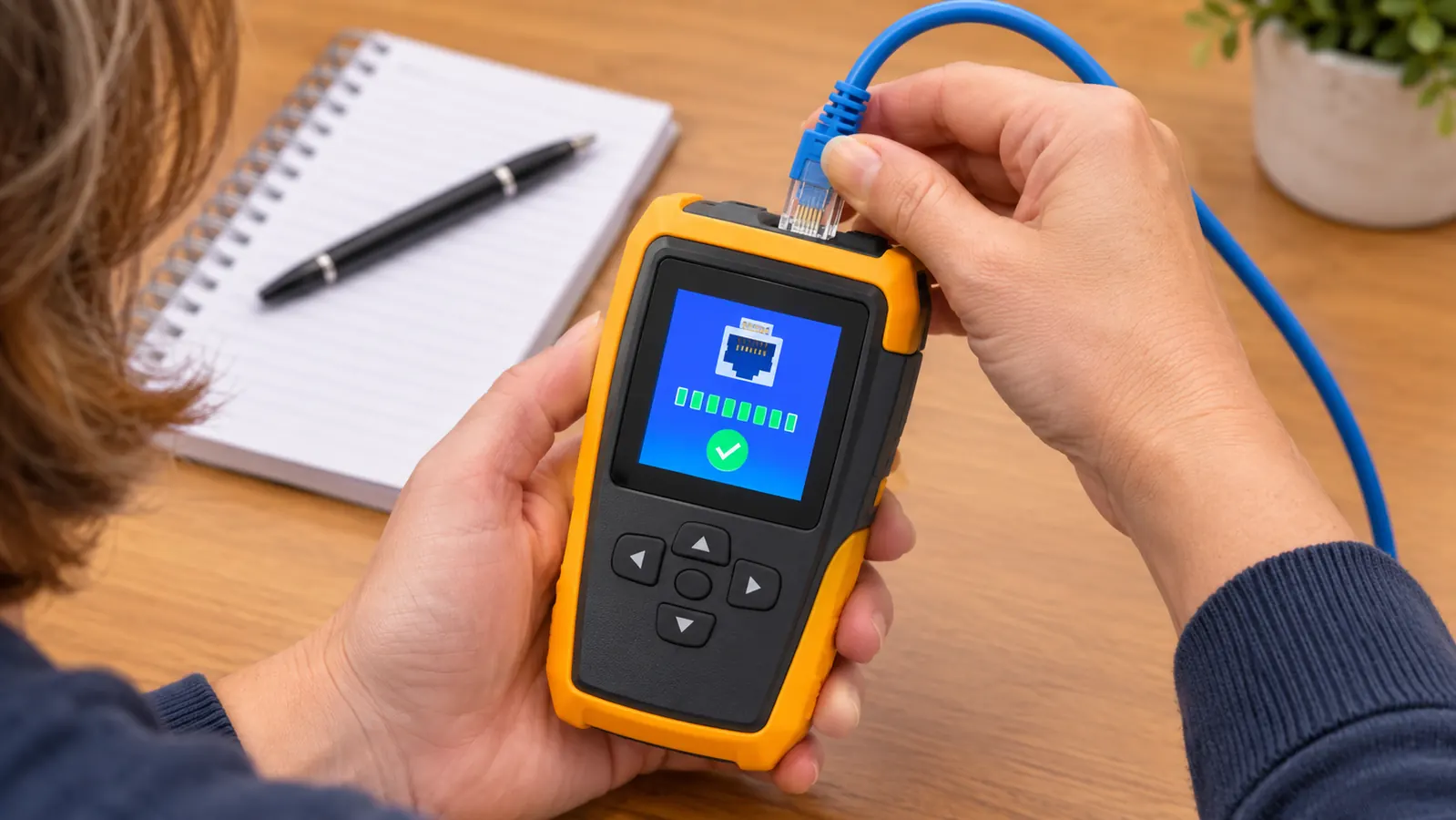
I bought the KLEIN TOOLS Scout Pro 3 in October 2025. It is thirteen months old now and it lives in the desk drawer in the back room. The set arrived with the tester, the numbered remotes, an adapter and a battery. It is battery powered, 6.9 by 3.2 by 1.5 inches, 454 grams with the battery in. I read the listing through twice before I ordered, because I have bought the wrong thing before and I did not want to do it again with something I could not explain to Walt.
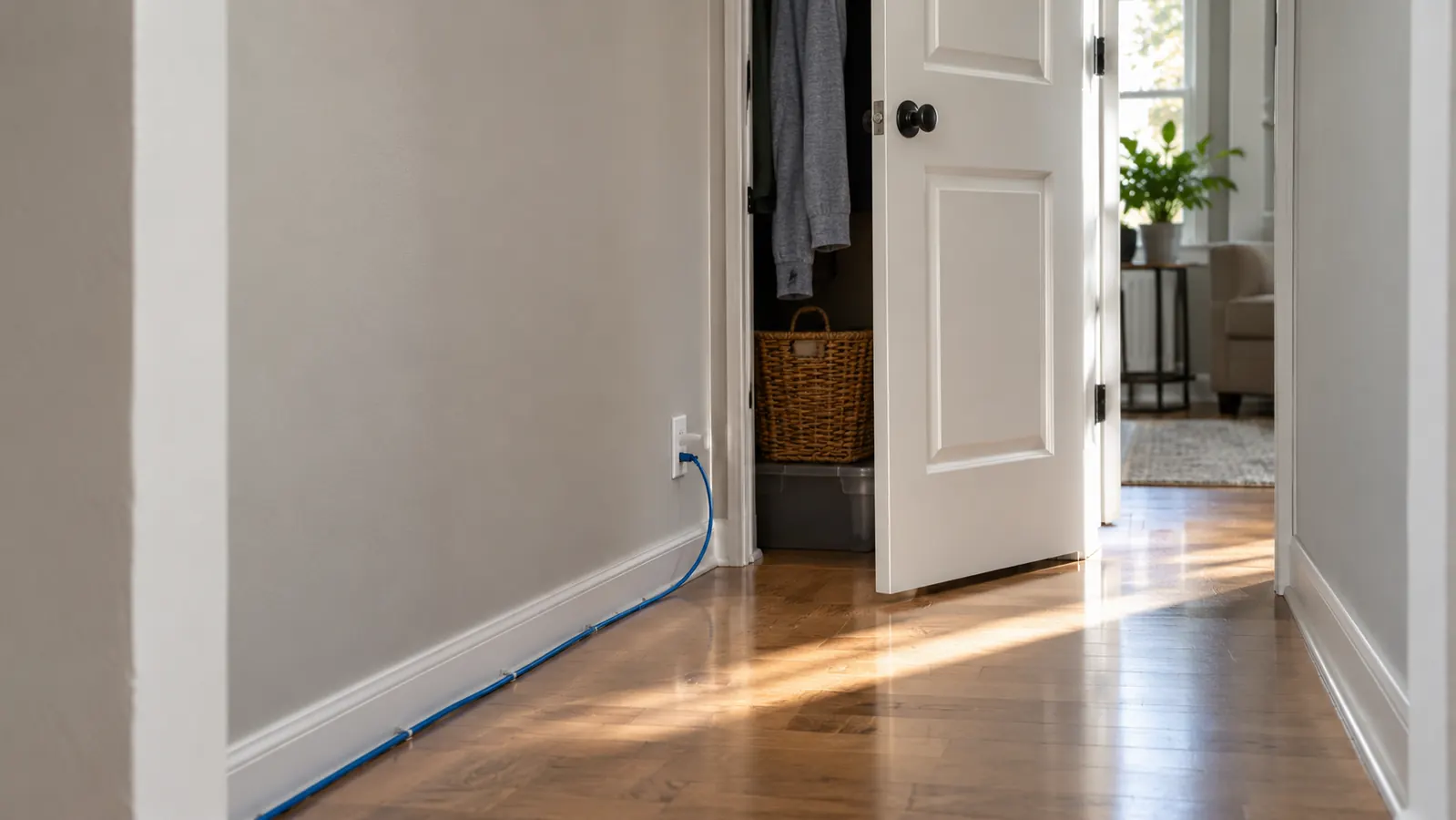
The cable run is the part worth telling. In October 2025 Walt and Theo spent a Saturday pulling one Ethernet cable through the attic, from the router in the hall closet to the desk in the back room. One run. That is the only one in this house and there will not be a second unless something breaks. When they finished I plugged one end into the tester and clipped the other end to the remote, and the screen said 46 feet. I had spent the better part of a year and a half reading about cable length. Then I knew the length of the cable in my own attic.
The screen said 46 feet. I had spent eighteen months reading about cable length. Then I knew the length of the cable in my own attic.
The tool that turned my attic cable into a lesson I could actually see
If you learn by putting your hands on the thing instead of staring at a diagram, this is the same set I bought in October 2025. It reads length and wiring order on cable that already has ends on it.
Amazon Check Today's Price on Amazon →Then I tested the box of ten patch cables Theo gave me. I did them one at a time at the desk, both ends, and wrote the results in the margin of my study guide. Nine passed. One failed. The wiremap on the failing cable showed a pair out of order, and I finally saw with my own eyes what the book meant when it talked about a split pair. The blinking tester could never have told me that. The bad cable went in the trash that night. The other nine are still in the drawer.
Here is the part I want to be straight about, because I have read reviews that make a tool sound like it does everything. It does not. It tests cable that already has ends on it, so it never made a single cable for me. I have never crimped anything and I do not own a crimper. I do not own a tone probe either. The listing mentions one, the VDV500-123, sold separately, for tracing a cable through a wall, and I have not needed it because my one run ends in a room I can walk into. And I do not test anything connected to live electrical wiring. Not once. That is a line I do not cross in this house.
What it actually changed was my study habit. The screen is backlit, which matters more than I expected, because my sessions run Tuesday and Thursday from 7 to 9 at night and the back room lamp is behind my shoulder. It reads voice, data and video cable, RJ11 and RJ12, RJ45, and coax with an F connector, and it measures up to 2000 feet. On real cable in this house I have used exactly one of those three. The rest I have only looked at on the screen while working through the manual. I take it out of the drawer maybe twice a month and I put it back the same night.
What I'd Tell You If We Were Sitting at My Kitchen Table
I would tell you that no tester was going to make the networking chapter make sense on its own. I bought mine after I had already read that chapter twice and failed to hold on to it. The tool did not teach me pinouts. It let me check whether I had learned them, and there is a difference there that took me a while to see. I would tell you to buy the thing you will genuinely reach for on a Tuesday at 8 pm when you are tired, not the largest set on the page. If you have one cable in your house and no crimper, then a tester that reads length and wiring order is enough, and anything bigger is money you did not need to spend. If you are going to be pulling cable through walls for a living, this is not the purchase you should be asking me about, and I would say so plainly. I would also tell you that failing Core 1 the first time did not mean what I thought it meant in February. I sat it again in May. I am studying for Core 2 now and I have not taken it. Nobody handed me anything. I still work the same billing job I have had for twenty four years, and I want that clear before you read one word of this as a promise about your own life.
One cable, one tester, and a Tuesday night that finally went somewhere
The KLEIN TOOLS Scout Pro 3 is the set in my desk drawer. If your studying has stalled at the same chapter mine did, it is worth a look.
Amazon Check Today's Price on Amazon →