
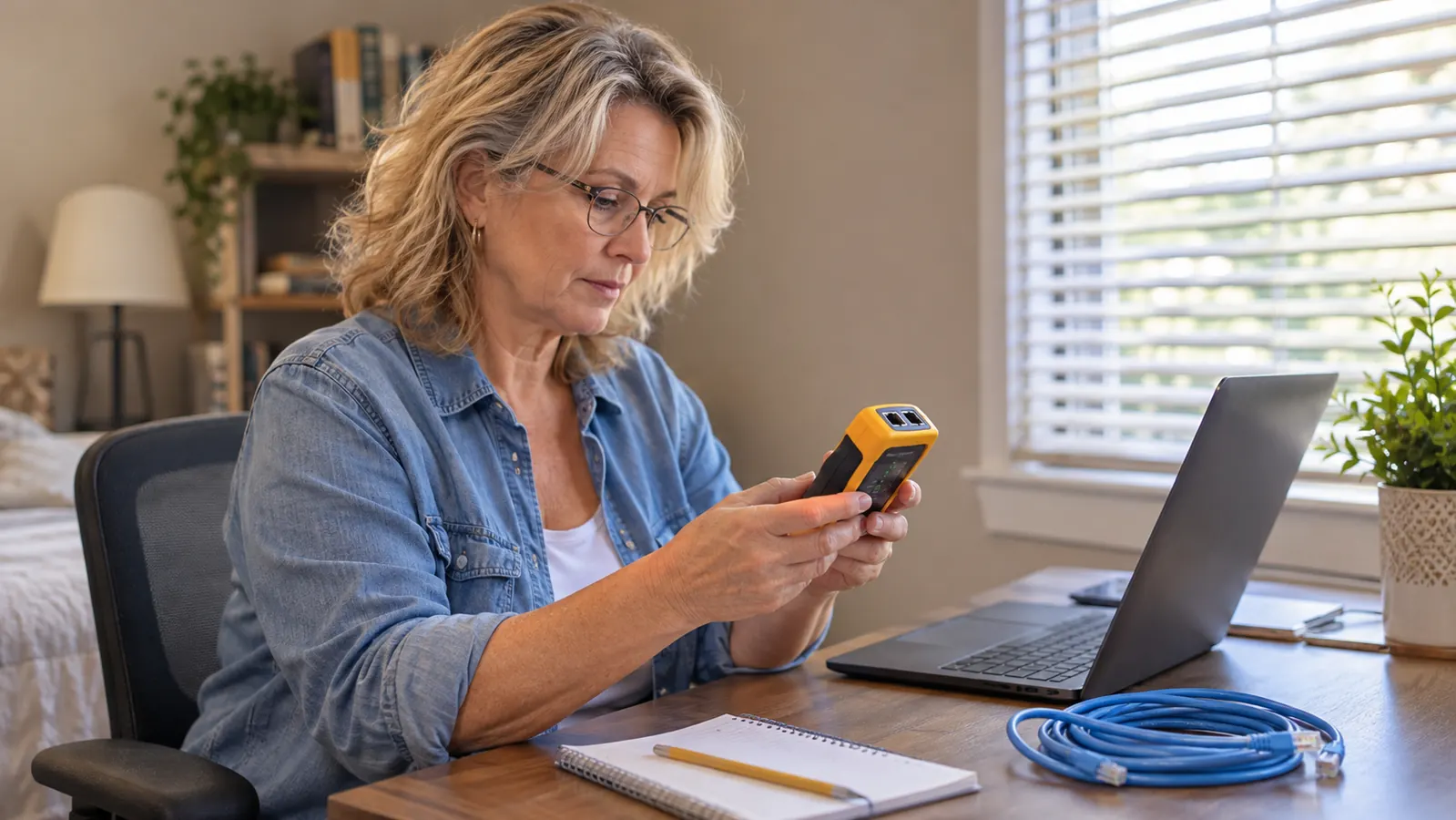
Two things I got wrong in my first year of studying for the CompTIA A+ had nothing to do with computers. The first was believing a network cable either works or it does not. The second was borrowing my nephew Theo's blinking-light tester for one weekend in September 2025 and deciding that was enough to understand cabling.
That little tester lit eight lights in a row and told me a patch cable was wired correctly. It could not tell me how long the cable was. It could not tell me which of the ten cables in the box Theo handed me was the one that kept failing. In October 2025 I bought the Klein Tools Scout Pro 3 starter set with my own money, and it has lived in the top drawer of my back room desk ever since. Thirteen months on, I use it about once a week and I have never had to look up how to turn it on.
The Quick Verdict
It answered the two questions my borrowed tester could not, on the first evening, without anyone talking me through it. The printed instructions assume you already speak the language, and the tone probe for tracing cable inside a wall is sold separately.
Amazon Check Today's Price →A row of blinking lights says a cable works. It never says the cable is 46 feet long.
The Scout Pro 3 reads length, wiremap, cable ID and pass or fail on a backlit screen, for voice, data and coax terminations. This is the set I bought in October 2025 and still keep in the desk drawer.
Amazon Check Today's Price on Amazon →How I've Used It
In October 2025 my husband Walt and Theo ran a single Ethernet cable through the attic from the hall closet, where the router sits, down into the back room where I keep the desk. It is the only network run in this house. When they came down, Theo handed me the tester and told me to read the length off the screen instead of guessing from the floor plan. The screen said 46 feet. I wrote 46 in a notebook with a pencil, and I have measured every other cable in the house against that number since. Before that afternoon I had been estimating the distance by counting floor joists from underneath, standing on a step stool with a flashlight, and I got it wrong twice, once by six feet and once by more than that. A guess written in a notebook looks exactly like a measurement written in a notebook, which is how a beginner ends up certain of something untrue. The 46 has a source. The guesses did not.
Theo also gave me a box of ten short patch cables from the school district's surplus pile. Nine passed. One failed on the wiremap and went into the trash that same evening. What I appreciated is that the tester told me which cable was bad without me having to plug and unplug all ten in a guessing order. I did not have to be clever. I just had to read.
The rest of my use is study. My schedule is Tuesday and Thursday evenings from seven to nine, plus Saturday mornings, at the kitchen table with one printed study guide. The networking objectives in Core 2 were a list of vocabulary words to me until I could hold a cable, plug one end into the remote that comes in the set, plug the other end into the tester, and watch a screen confirm the order of the wires inside it. I am not going to tell you this got me a job. I still work full time in hospital billing and that has not changed. What changed is that a term I had read forty times finally meant something in my hands.
I remember the first Saturday I used it without Theo in the house. I tested the same patch cable three times because I did not trust a good result. That is the beginner problem in one sentence, and having a screen that repeats the same answer is what fixed it.
For the record, I have never crimped a cable. I own no crimper, no punch-down tool and no tone probe. The tester is the whole of my networking kit. Everything below is one person, one cable run and a box of ten patch cables.
What the Scout Pro 3 Actually Tests
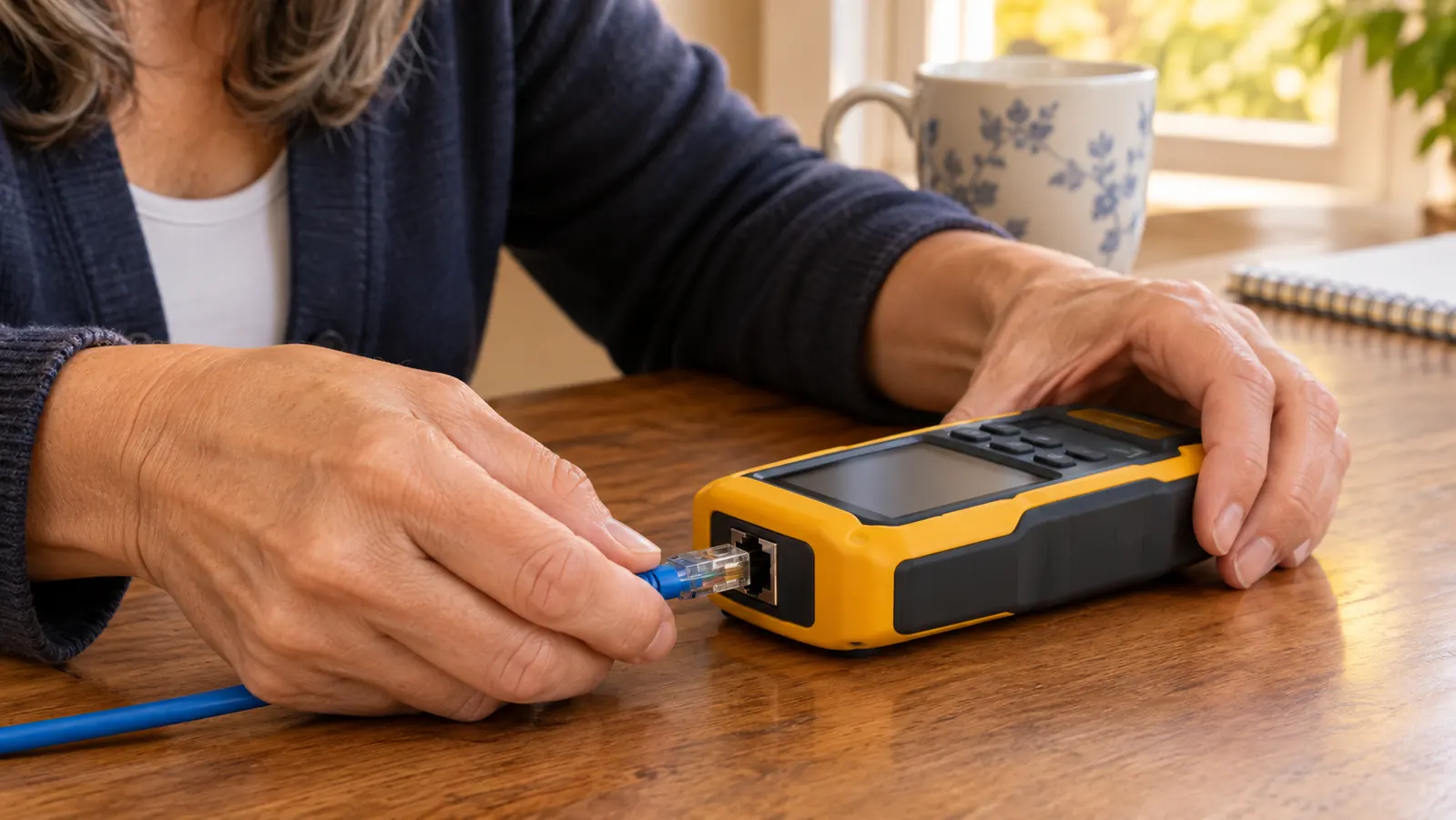
The set handles three kinds of terminated cable. Voice cable means the RJ11 and RJ12 jacks on a telephone line. Data cable means the RJ45 jack that an Ethernet cable ends in. Video cable here means coax with an F-connector on the end, the round screw-on fitting behind a television or a cable modem. My house only uses the data kind regularly, but I tested an old phone jack as well, because the set does it and because I wanted to see a different result on the screen for myself.
The screen is a backlit LCD. That matters more than it sounds. The back room has one lamp in it and I do most of this work after dark, and I can read length, wiremap, cable ID and the pass or fail result on it without tipping it toward the light or putting my glasses on twice.
Klein Tools rates the length measurement up to 2000 feet, or 610 meters. My longest cable is 46 feet, so I am using a small fraction of what it can do. If you are the person who needs to know how much is left on a box of cable, that figure is the reason to buy this rather than a tester that only blinks.
The starter set includes remotes, an adapter and a battery. The remotes are what make the cable ID part work. You leave one on the far end of a run and the tester tells you which remote it has found. With one run in the house I do not need that. If you were labelling eight runs into a panel, you would lean on it constantly, and it is the part of this set I understand best on paper and least in practice.
The Length Reading Is the Part I Did Not Expect to Use
I thought I was buying a pass or fail machine. The length reading turned out to be the part I reach for most, because it answers a question a blinking tester cannot even ask.
When the attic run was new, I had no way of knowing whether the cable had been cut to a sensible length or damaged during the pull. Forty-six feet on the screen matched roughly what Theo had estimated from the footprint of the house, and that was my first real evidence that the run was healthy rather than merely connected. A cable can pass a wiring check and still be a mess. The length number is a second opinion.
The nine patch cables that passed all read within a couple of inches of the three feet they were sold as, which I had never once thought to check. It is a small thing. It also taught me that a short cable has a length worth knowing, and that if a cable ever reads far longer than it should, the signal is not travelling the straight path you think it is. That is the kind of detail I would have skipped over in the study guide, and I only sat still for it because I had already seen the number myself.
Klein Tools also sells a tone probe separately, and the listing for this set mentions it. A tone probe is what lets you follow a cable through a wall or a bundle without unplugging anything. I do not own one. My one run comes out of a closet where I can see both ends, so I have never needed to trace anything. If your cable vanishes into a wall and reappears somewhere you cannot identify, plan for the probe as a second purchase rather than expecting this set to do that job.
Where It Confused Me at First
My first evening with it went badly, and the reason was simple. I plugged one end of a known good patch cable into the tester and left the far end loose on the desk. A cable with nothing on the other end reads as a failure. I spent twenty minutes convinced a good cable was bad and wondering whether I had been sold a broken set.
Then I tried a second cable and got the same failure. Then a third. By the third one I had decided the set was faulty and was working out whether I could drive it back to the store on a weeknight, which is a two hour round trip from Knoxville traffic that I did not want to make. What stopped me was a habit left over from the electronics kit I worked through in 2024: when every single test returns the same wrong answer, the problem is usually upstream of the test, not inside the instrument. I read the instructions again, found the word remote, and understood that the far end needs a termination on it. The tester was never broken. My setup was.
The word wiremap confused me for longer than I want to admit. It is just the order the wires inside the cable arrive in. If the order is wrong, the cable is wired wrong, even if both ends click in neatly and look perfectly fine from the outside. Once Theo said that out loud, the display made sense and stopped looking like a code I had to memorise.
There is an adapter in the set. I ignored it for about two months because the printed instructions did not explain it in words I could follow, and I have not needed it for the cables in this house. That is not a fault in the adapter. It is a fault in the instructions, which are written for someone who already knows the vocabulary. I read them twice and then asked Theo.
Two evenings of use and I was comfortable. That is the honest learning curve for someone who had never held a cable tester before September 2025, and I would rather tell you two evenings than two minutes.
What It Does Not Do
It does not trace cable through a wall on its own. That is the tone probe, sold separately, as above.
It is rated for a maximum operating voltage of 66 volts of direct current, with a minimum operating voltage of 9 volts. That is the number I keep in my head when I decide whether something is safe to put a lead on. I have never tested anything connected to live electrical wiring, and I would not treat this as a reason to start.
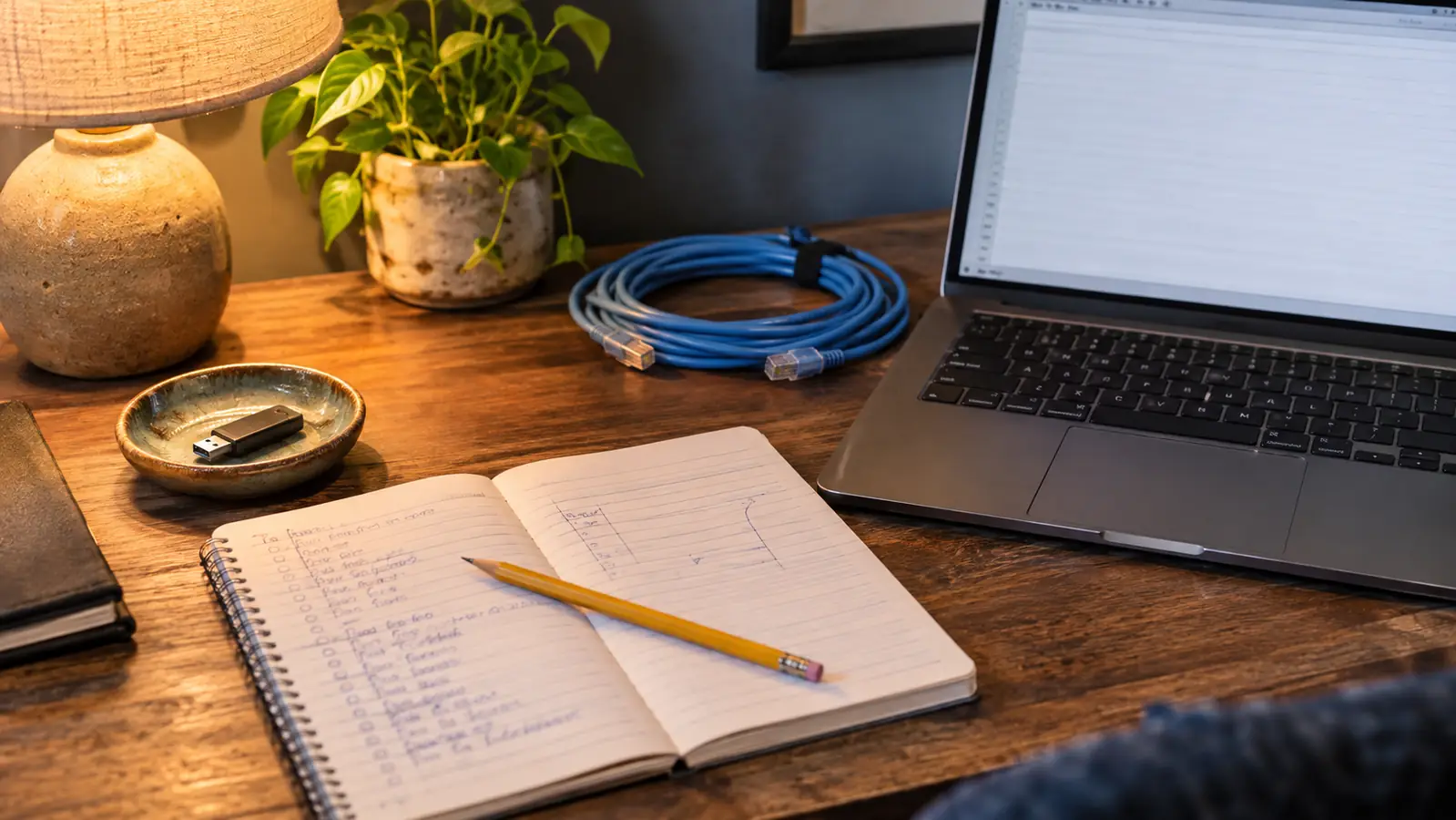
There is no app and nothing to pair. Results go in a paper notebook in pencil. For me that is an advantage, because the notebook does not need charging, but if you expected a screen on your phone you should know that is not what this is.
That notebook has a page for every cable in this house now, with the date, the length and the result written in pencil. It sounds fussy for a house with one run. It has been the single most useful habit I picked up, because when the attic cable started behaving oddly in a way I could not put into words, I could turn back and see that the length reading had not moved since the first afternoon. If it had moved, that alone would have told me something had been disturbed up there, and I could have said so to Theo instead of describing it as slow.
It tells you the wires are in the right order and how long the cable is. It does not tell you how fast that cable will carry data over a given distance. That is a different class of instrument and a much larger purchase, and I am not qualified to review one.
It weighs 454 grams and measures 6.9 by 3.2 by 1.5 inches, so it fits in a desk drawer with room to spare. The upper temperature rating is 60 degrees Celsius, which is why mine comes indoors after a summer afternoon instead of living in the attic next to the run. The warranty line says to call the vendor, and in thirteen months I have never had a reason to.
What I Liked
- Reads cable length up to 2000 feet, which is the one number a blinking tester cannot give you
- Tests voice (RJ11/12), data (RJ45) and coax with an F-connector from a single handheld set
- Backlit LCD shows length, wiremap, cable ID and the result, readable in a dim room after dark
- Starter set includes remotes, an adapter and a battery, so it works the first evening
- Small and solid enough to live in a drawer: 454 grams, 6.9 by 3.2 by 1.5 inches
- Thirteen months of weekly use and nothing has failed or needed replacing
Where It Falls Short
- The printed instructions assume you already know the vocabulary
- The tone probe for tracing cable inside a wall is sold separately
- Rated to 66 volts of direct current, so it is not for anything connected to mains wiring
- More tester than a house with one cable run genuinely needs
One cable out of ten failed. The tester named it on the first pass and it went in the trash. My borrowed tester would have had me guessing all evening.
Who This Is For
This is for the person learning on their own who has cables in front of them and nobody to ask. Adults going back to school at night, hobbyists wiring one room, anyone studying an entry-level certification who wants the networking vocabulary to stop being abstract. It suits a house with a couple of runs and a box of patch cables, and it suits a beginner because the answer arrives on a screen as words and numbers rather than as a pattern you have to memorise. If you know someone who learns by taking things apart, this is the same idea applied to cable.
Who Should Skip It
Skip it if you have one cable, no interest in cabling and only want to know whether the internet works. A blinking tester and a laptop will answer that. Skip it if you need to trace cable inside finished walls, because you will be buying the tone probe anyway and should plan for both at once. Skip it if you need performance testing rather than continuity and length. And skip it if you want something that explains itself. The instructions are the weakest part of the set, and a patient nephew is not included in the box.
Start with the question your blinking tester cannot answer.
Length, wiremap, cable ID and pass or fail, on voice, data and coax terminations, from one handheld set with the remotes and battery included. Thirteen months in a desk drawer and it still reads 46 feet on the run through my attic.
Amazon Check Today's Price on Amazon →