
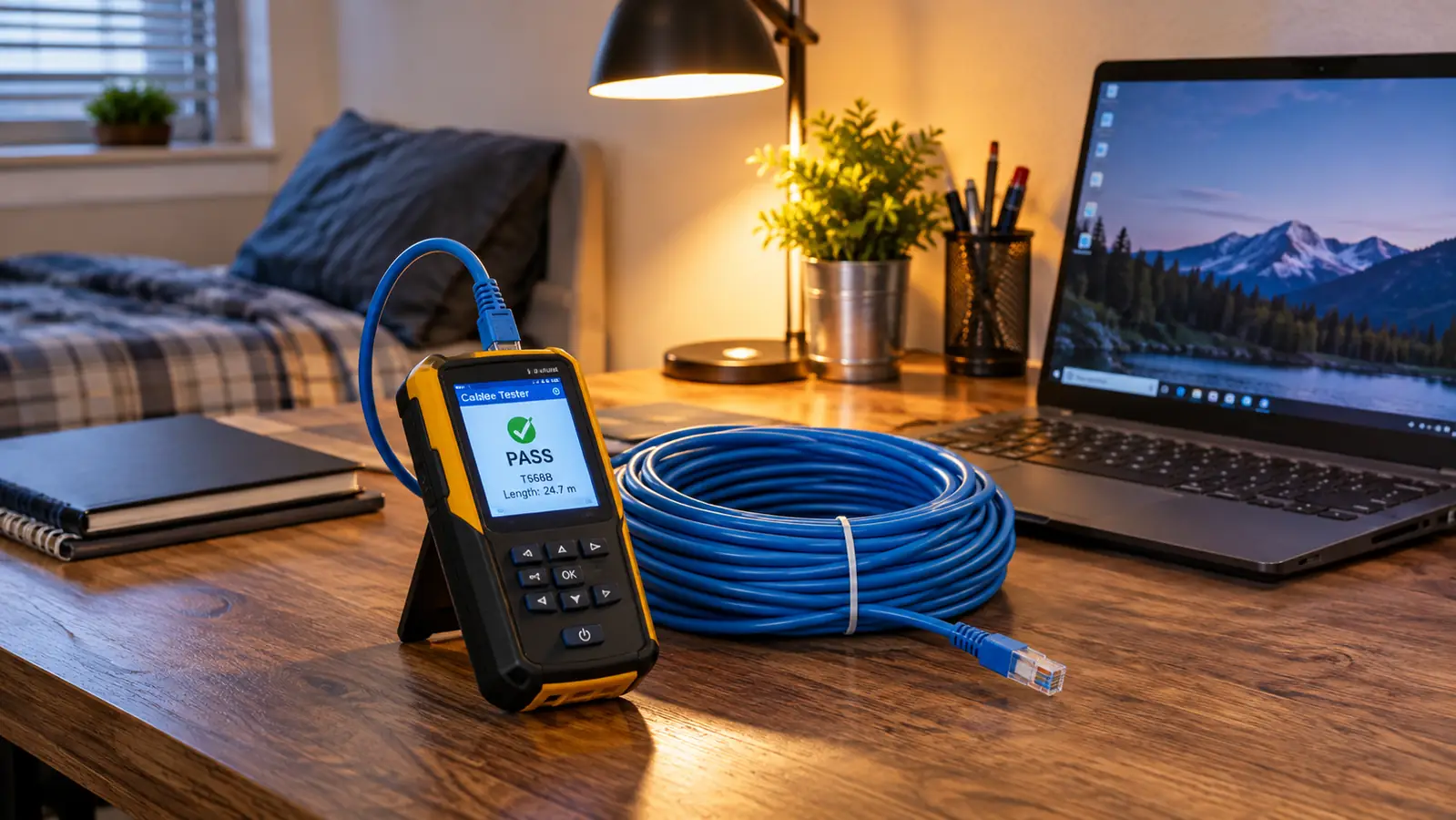
I bought the KLEIN TOOLS Scout Pro 3 in October 2025 for one narrow reason. My study book kept telling me to verify a cable before I trusted it, and I had no way to do that. I could plug a cable in and hope. That is not verifying. It is guessing with extra steps. I am 56, I have worked in hospital billing for 24 years, and I study for CompTIA A+ at my kitchen table on Tuesday and Thursday nights. The networking chapter was the first part of this whole project that made me feel genuinely stupid, because the failures it describes are invisible. A bad cable looks exactly like a good cable. Thirteen months later I can tell you what the KLEIN TOOLS Scout Pro 3 does well, what it does not do at all, and where I think the usual descriptions of it get it wrong.
The short version, before the long one. This is a tester. It is not a teacher and it is not a trainer, and it will not tell you why a cable failed. It tells you whether the wires inside a cable are connected the way they are supposed to be, how long the cable is, and which cable in a pile of identical cables you are holding. For someone studying at a kitchen table, those three answers cover most of what the books ask you to check. For someone who wants to trace a wire through a wall, it covers none of it unless you buy a second piece of equipment that is not in this box.
The Quick Verdict
Narrow, honest and well made. It answers three questions about a cable and refuses a fourth, and knowing which is which is most of what you need before you buy.
Amazon Check Today's Price →The tester I reach for before I trust a cable
It reads wiremap, length and cable identification on voice, data and coax cables, and it has lived in my desk drawer for thirteen months without a single problem.
Amazon Check Today's Price on Amazon →What the Scout Pro 3 Actually Is
The box holds the tester itself, a set of remotes, an adapter and a battery. It runs on that battery, so there is nothing to plug into a wall and nothing to install on a computer. The tester body is 6.9 by 3.2 by 1.5 inches and weighs 454 grams. That is heavier than a television remote and lighter than a hammer, and it feels like a tool rather than an accessory. The screen is backlit, which I did not think I cared about until I started working at night in the back room with one lamp on.
It handles three kinds of terminated cable. Voice cable with the small telephone connector, which the listing calls RJ11 and RJ12. Data cable with the wider eight-pin connector, RJ45, which is what an Ethernet cable has on each end. And video cable with the round connector, which the listing calls a coax F-connector. Terminated is the word that matters here. The ends have to be on the cable already. This is not a tool for testing a bare spool of wire, and if that is what you pictured, it is not that.
The screen answers three questions. Wiremap is the first. A network cable has eight wires inside it, and each one has to land on the correct pin at both ends. Wiremap shows you, pin by pin, what is connected to what. When the eight wires line up properly you get a clean pass. When they do not, you get a picture of exactly which pin is out of place. Length is the second, and the listing says it measures up to 2000 feet, or 610 meters. Cable ID is the third. The remotes in the kit sit on the far end of a cable and tell the tester which cable you are holding, so a drawer full of identical cables stops being a guessing game.
Two things about the range and the connectors, because I do not want to oversell what I have seen. The 2000 foot length figure is far past anything in my house, and the longest cable I have ever measured is a 46 foot run. I have tested data cable and nothing else. I have not put a telephone cable or a coax cable on it, so I cannot tell you how those behave. What I can tell you is that the KLEIN TOOLS tester has done everything the listing promised on the cables I actually own.
How I've Used It
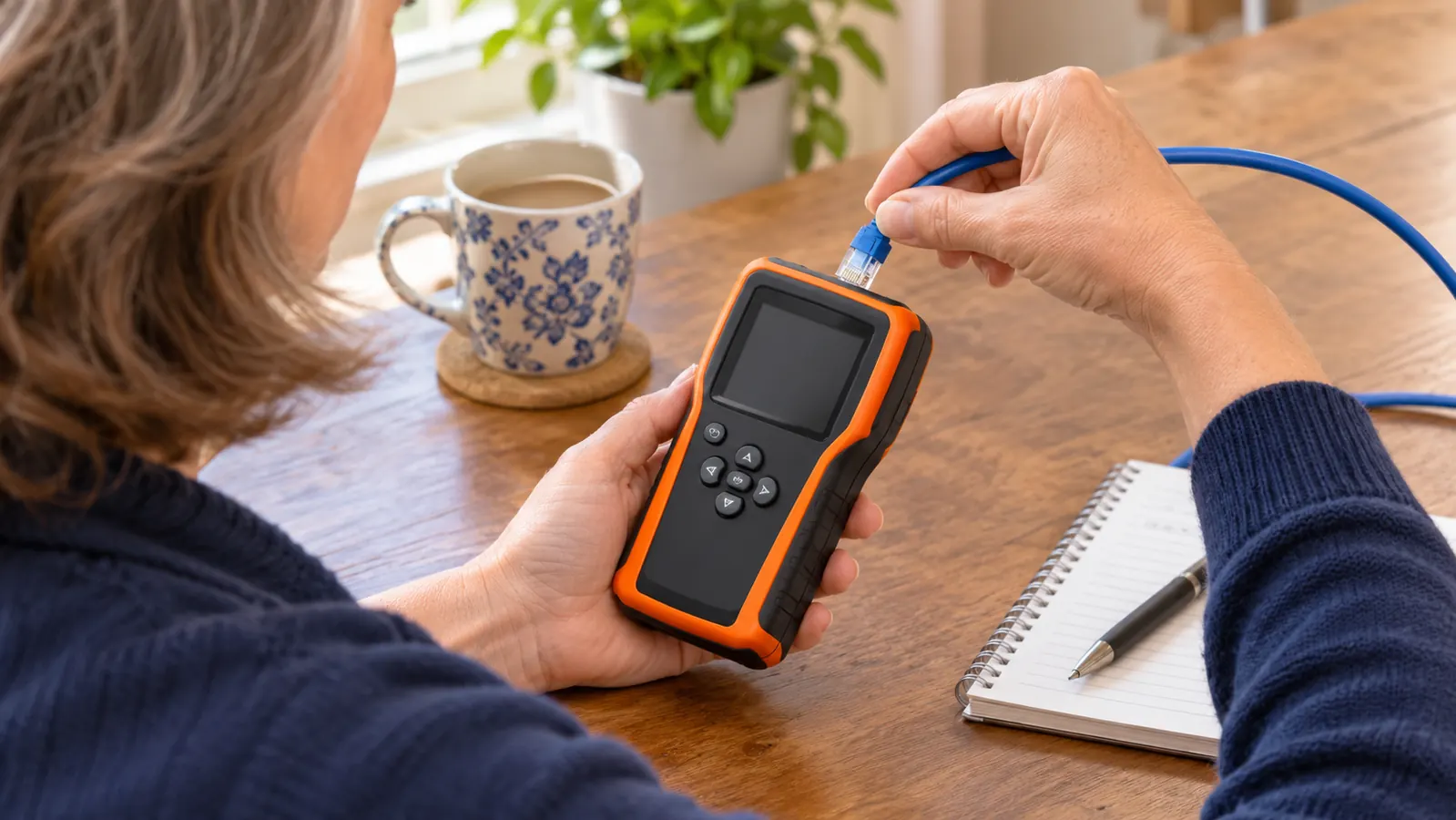
In October 2025 my husband Walt and my nephew Theo ran one Ethernet cable through the attic, from the hall closet where the router lives to the back room where I work. Walt is 59 and retired from the post office. Theo is 31, works as a network technician for a school district, and is the person I ask when I do not understand something. They pulled the cable, put the ends on, and then handed me the tester instead of telling me it was fine. The run reads 46 feet. It is the only permanent run in this house, so I cannot tell you how the tester behaves in a building full of cable.
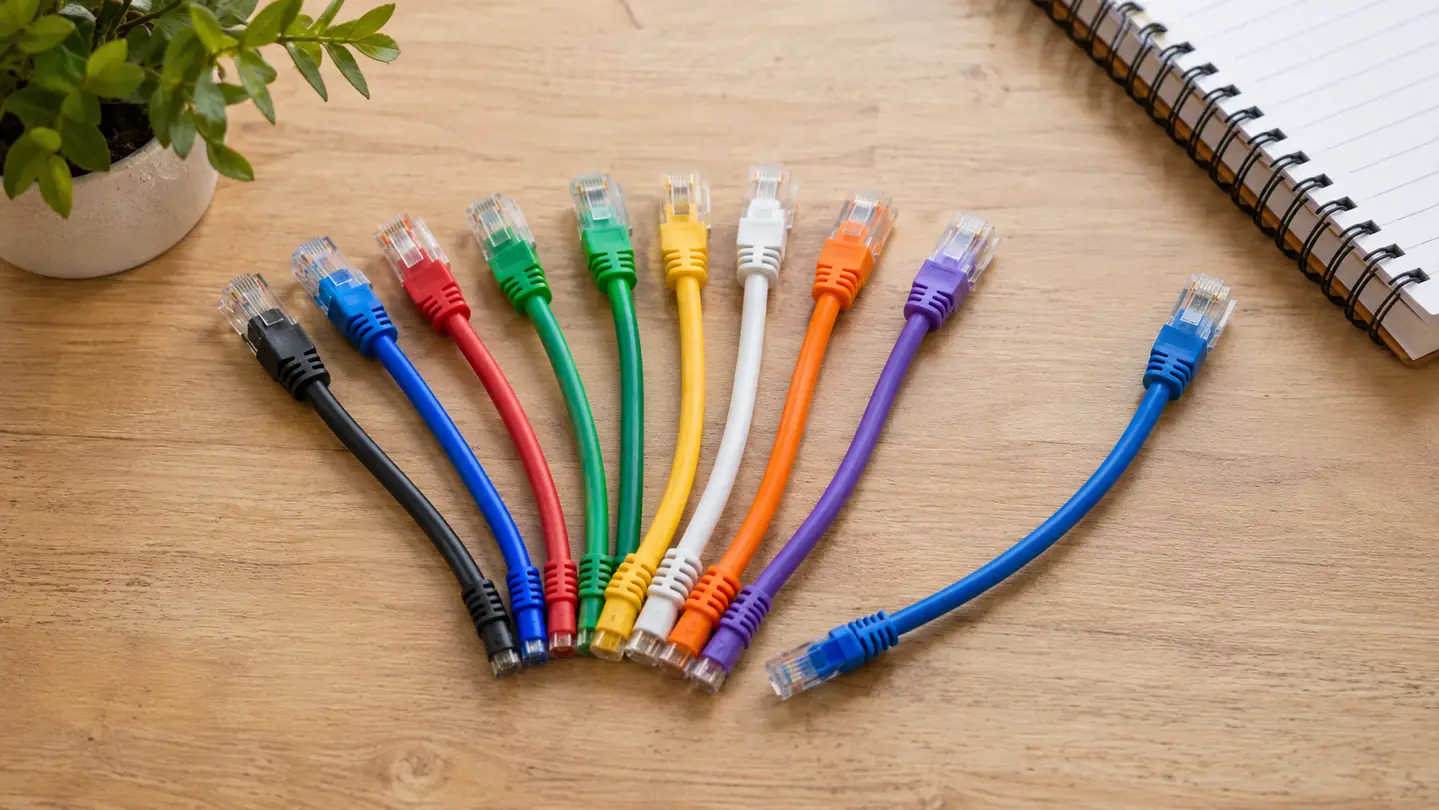
The more useful job came later. Theo gave me a box of ten short patch cables, the kind that arrive free with equipment and then live in a drawer forever. I tested all ten at the kitchen table on a Saturday morning. Nine showed a clean wiremap. The tenth showed a pair of wires that did not land where they were supposed to. Nothing dramatic happened. I put that cable in the trash and stopped wondering why one port on my used practice laptop seemed flaky.
What I have not done with it matters as much as what I have. I have never crimped a cable and I do not own a crimper, so every cable I have tested arrived with its ends already attached. I do not own a tone probe, and I have never used the tester to find a wire inside a wall. I have never used it anywhere near house current. My routine is a cable on a towel on the desk, ends in the ports, reading on the screen. That is the whole of my experience, and I would rather tell you that than pretend to more.
The way it fits into study is small and specific. On study nights I keep the tester on the desk with two patch cables, one good and one bad, and I read the wiremap on each before I open the book. Seeing the difference on the screen makes the diagram in the chapter mean something instead of being a drawing of pins. That is a ten minute habit, and it is the most useful ten minutes of my Tuesday.
How It Compares With a Cheap Blinking Tester
I borrowed Theo's cheap tester for one weekend in September 2025, the kind with a row of lights that blink in sequence. It told me a cable was continuous. It did not tell me how long the cable was and it did not tell me which cable in a pile I was holding. For a person checking one cable at a time, that is often enough, and I want to be fair about it. The blinking tester cost Theo almost nothing and it lives in his bag. If your only question is whether a cable works at all, that tool answers it.
What the Scout Pro 3 adds is the picture underneath the answer. Wiremap showed me which pair failed on the tenth cable, not merely that the cable failed. The length reading told me the attic run was 46 feet rather than the 60 feet Walt guessed. For studying, that difference matters, because the material asks you to understand what is happening inside the cable, and a row of blinking lights does not show you the inside of anything. The blinking tester tells you yes or no. This one shows you the working.
Nine of the ten patch cables gave me a clean wiremap. The tenth showed two wires that never arrived where they were supposed to. That was the whole answer, and it took about four minutes.
What Nobody Tells You
It tells you that a cable is wrong. It does not tell you why, and it does not repair anything. When the tenth patch cable failed, the screen showed me which pins were out of order. It could not tell me whether the end had been crimped badly, whether a wire had been cut inside the jacket, or whether someone had shut a desk drawer on it. Reading a wiremap is a skill you bring to the tool. The tool does not bring it for you.
Tracing a cable through a wall needs a second tool that is not in this box. The listing mentions a tone probe, the VDV500-123, sold separately. A tone probe is the wand you run along a bundle of wires to work out which one you are sending a signal down. I do not own one and I have never used one. So when a description calls this a cable tracing kit, it is describing the tester plus something the buyer purchases separately. If your reason for wanting this is a wire lost behind drywall, plan for both pieces or the box will disappoint you.
The voltage limit is real and it is a hard line. The listing gives a maximum operating voltage of 66 volts of direct current and a minimum operating voltage of 9 volts. That is nowhere near house current. This is not a multimeter and it is not a tool for anything live. I say that plainly because a device with a screen and a battery can look like it might do more than it does. If you are curious about what happens inside a wall socket, that is a different instrument, a different set of safety rules, and a subject I stay away from.
There is housekeeping. The kit arrives with several remotes and an adapter, and they are small. Mine live in a small dish in a drawer in the back room, because in the first month I lost one of the remotes for four days. It was behind the printer. If you are a person who loses small pieces, this kit will find that out about you.
The screen is small, and it is not a phone. If your eyes are the age mine are, you will hold it closer than you expect. That is not a complaint about the tool. It is a note for the person who is 54 and worried that everything about this will feel like it was built for somebody else. This one was not. The reading is plain, numbers and pin positions, and I was reading a wiremap correctly inside ten minutes.
And it does not teach you anything by itself. I have read descriptions that make this sound like a course in a box, and it is not. No exam asks whether you own a tester. I failed Core 1 in February 2026 and passed it on the second try in May 2026, and I am studying for Core 2 now. No tool did that for me. What the KLEIN TOOLS tester did was let me check something with my hands on a Saturday morning instead of reading about it for the fourth time, and learning with my hands is the only kind that has stuck. That is a smaller claim than the packaging makes. It is the one I can stand behind.
What I Liked
- Reads wiremap pin by pin, so a failure shows you which wire is wrong instead of only that something is wrong
- Measures length, and it matched my one attic run at 46 feet
- The remotes identify which cable in a pile you are holding, which a blinking tester cannot do
- Handles voice, data and coax ends, so it covers the connectors the networking material talks about
- Backlit screen is readable at night in a dim room
- Feels solid at 454 grams and has survived thirteen months loose in a desk drawer
Where It Falls Short
- Tells you where a cable failed, not why
- Tracing a cable inside a wall needs the tone probe sold separately, which I do not own
- Not a multimeter and not for anything live. The limit is 66 volts of direct current
- The remotes and adapter are small and easy to lose
- The 2000 foot length range is far beyond anything I will ever test and I cannot vouch for it
Who This Is For
This suits a person learning networking with their hands rather than only from a book. If the material keeps telling you to verify a cable and you have no way to do it, this is the thing that lets you do it. It also suits a homeowner with a handful of permanent runs who wants to know which cable is which and how long each one is. And it suits anyone who has stood in front of a drawer of identical patch cables with no way to tell them apart. I would put the KLEIN TOOLS Scout Pro 3 in a beginner's hands before I would put a cheap blinking tester there, not because the cheap one is bad, but because the wiremap is the part that teaches you something.
Who Should Skip It
Skip it if the wire you care about is inside a wall, because you will also need the tone probe that is sold separately. Skip it if what you actually want is a multimeter, since this is not one and cannot become one. Skip it if you are troubleshooting a live circuit, because the limit is 66 volts of direct current and house current is not a thing to learn on. Skip it if a blinking continuity tester already answers your question and you have no interest in wiremap or length. And skip it if you want something to teach you. This is a measuring tool. The teaching is the book, the practice machine, and the two evenings a week you sit down with them.
One cable, three answers, about a minute
Wiremap, length and cable identification on voice, data and coax. Thirteen months in a desk drawer and it still reads the same as the day I opened the box.
Amazon Check Today's Price on Amazon →